
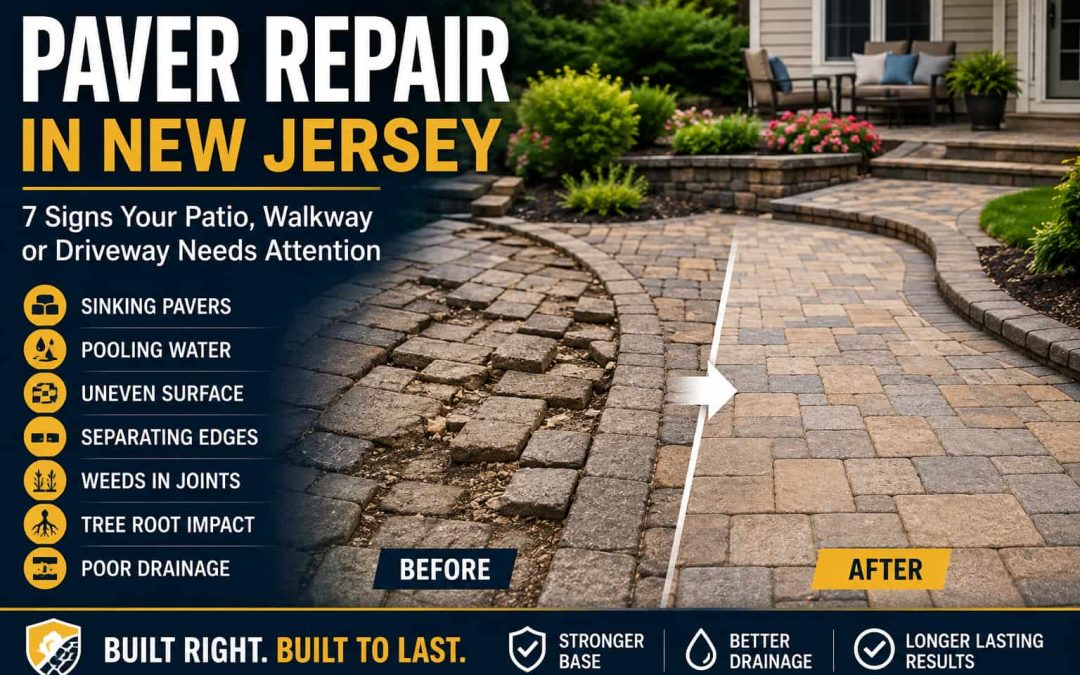
Pavers that are sinking, shifting, separating, or collecting water usually indicate a problem that goes beyond appearance. In many cases, professional paver repair in New Jersey can correct the affected area without requiring homeowners to replace the entire patio, walkway, or driveway.
The key is identifying why the pavers are failing before repairing them.
New Jersey properties experience rain, snow, freezing temperatures, summer heat, soil movement, and repeated freeze-thaw cycles. When drainage, base preparation, compaction, or edge support isn’t performing correctly, those conditions can expose weaknesses in an existing paver installation. Resources from Rutgers University provide information related to environmental and landscape sciences, offering useful context for understanding how site conditions can affect outdoor surfaces.
If you’re noticing these issues, professional paver repair in NJ can help identify the underlying problem and determine whether targeted repairs or more extensive restoration are appropriate.
Here are seven warning signs homeowners shouldn’t ignore.
1. Your Pavers Are Sinking
Sunken pavers are one of the most noticeable signs that a paved surface needs attention.
You may notice one section of a patio sitting lower than the surrounding area or individual pavers beginning to form a depression.
Possible contributing factors include:
- Base settlement
- Insufficient compaction
- Erosion beneath the pavers
- Drainage problems
- Soil movement
- Poor previous installation
The important point is that raising the visible paver isn’t necessarily enough.
A professional repair should investigate what caused the area underneath it to lose stability.
Otherwise, the same problem may return.
2. Water Is Pooling on Your Patio or Walkway
Standing water shouldn’t automatically be dismissed as normal after heavy rain.
If water consistently collects in the same location, the surface may have developed a low spot or the original grading may not be directing water effectively.
Over time, drainage issues can affect both the usability and stability of the area.
Water management becomes particularly important when the paved surface is located near:
- Foundations
- Steps
- Doors
- Retaining walls
- Garden beds
- Pool areas
A paver repair contractor should evaluate the grade and surrounding drainage conditions, rather than simply replacing individual pavers.
3. Pavers Have Become Uneven
An uneven paver patio isn’t just an aesthetic problem.
Raised or sunken sections can create an uncomfortable walking surface and potentially become a tripping concern.
Unevenness can develop gradually, making it easy for homeowners to overlook until the difference becomes significant.
The repair may involve carefully removing the affected pavers, evaluating the underlying material, rebuilding or correcting the base where appropriate, and reinstalling the surface.
4. The Edges Are Separating
The perimeter of a paver installation plays an important structural role.
When edge restraint fails or surrounding conditions change, pavers near the outside of a patio or walkway may begin moving outward.
Once movement starts at the perimeter, gaps can become progressively more noticeable.
Look for:
- Expanding joints
- Pavers moving away from one another
- Curved borders losing their shape
- Loose perimeter pavers
- Sections no longer following the original design
Repairing the problem early may prevent the affected area from becoming larger.
5. The Joints Between Pavers Are Deteriorating
The joints between individual pavers are part of the overall system.
When joint material deteriorates or disappears, you may begin noticing wider gaps, loose material, movement, or unwanted growth between the pavers.
However, simply adding new joint material isn’t always the complete solution.
Before restoring the joints, the contractor should determine whether the pavers themselves remain properly aligned and stable.
If the underlying surface has moved, that problem should be addressed first.
6. Tree Roots or Landscape Changes Are Affecting the Surface
Landscaping is constantly changing.
Trees mature. Roots expand. Soil conditions change. Water takes new paths through a property.
A patio or walkway that performed well for years can eventually be affected by changes in the surrounding landscape.
If tree roots are pushing a section upward, simply resetting the pavers without addressing the underlying cause may provide only a temporary improvement.
The surrounding landscape needs to be considered as part of the repair strategy.
7. Your Paver Surface No Longer Drains Like It Used To
This is an important warning sign homeowners sometimes miss.
Suppose your patio previously drained normally after rain, but now water remains in one area.
Something may have changed.
Possible causes include:
- Settlement
- Soil erosion
- Movement of the base
- Changes to surrounding landscaping
- Drainage alterations
- Nearby construction
- Gradual movement of the paved surface
Changes in drainage patterns are worth investigating before they become larger problems.
Why Do Pavers Sink or Shift?
One of the biggest misconceptions about paver repair is that the problem is always the paver itself.
Usually, the visible paver is only part of the story.
A paved surface works as a system involving the soil, base, bedding layer, individual pavers, joints, drainage, grading, and perimeter restraints.
When one component fails, movement can appear at the surface.
| Visible Problem | Possible Underlying Cause | Typical Evaluation |
|---|---|---|
| Sunken pavers | Base settlement or erosion | Inspect affected base |
| Standing water | Low area or grading issue | Evaluate drainage and slope |
| Separating edges | Edge restraint failure | Inspect perimeter |
| Uneven surface | Base or soil movement | Remove and inspect affected section |
| Loose pavers | Joint or base problems | Check joints and support |
| Raised pavers | Roots or ground movement | Inspect surrounding conditions |
| Recurring repairs | Underlying cause wasn’t corrected | Evaluate complete installation |
This is why a quality repair should start with diagnosis—not simply cosmetic correction.
Can Sunken Pavers Be Repaired Without Replacing the Entire Patio?
Often, yes.
One of the advantages of individual pavers is that a contractor may be able to remove and reinstall a localized section.
Depending on the cause and condition, the process may involve:
- Removing affected pavers.
- Inspecting the material underneath.
- Correcting damaged or settled areas.
- Reestablishing the appropriate grade.
- Reinstalling the pavers.
- Restoring the joints and surrounding area.
- Checking the repaired section for stability and drainage.
However, localized repairs aren’t always appropriate.
If problems are widespread throughout the patio or driveway, more extensive reconstruction may make better financial sense.
Repair or Replace? How Do You Decide?
This should be determined by the condition of the entire paver system, not simply its age.
Repair may make sense when:
- Problems are limited to a particular section.
- Most existing pavers remain in good condition.
- The underlying problem can be corrected locally.
- The homeowner wants to preserve the existing design.
More extensive removal and replacement may need to be considered when:
- Settlement affects large portions of the surface.
- Drainage problems are widespread.
- The original base appears inadequate.
- Multiple sections repeatedly fail.
- The homeowner wants a completely different layout.
- Significant property changes require redesigning the area.
A professional inspection can help determine which approach makes more sense.
Can Old Pavers Be Reused?
In some projects, existing pavers that remain in good condition may potentially be reused.
This can be particularly useful when a homeowner likes the existing style but needs the underlying installation corrected.
However, the pavers should be inspected individually for excessive damage, deterioration, or other issues before reuse.
The ability to reuse existing materials will depend on the specific project.
Why New Jersey Paver Repairs Require Attention to Drainage
New Jersey’s seasonal climate makes drainage especially important.
Outdoor surfaces are exposed to:
- Heavy rain
- Snow
- Ice
- Freezing temperatures
- Thawing
- Summer heat
Water entering unstable areas and repeated freezing and thawing can contribute to movement over time.
That’s why repairing a low section without considering where the water is coming from and where it should go may leave the real problem unresolved.
What Should You Ask a Paver Repair Contractor?
Before hiring someone to repair your patio, driveway, or walkway, ask:
What do you think caused the problem?
This may be more important than asking how quickly the contractor can repair it.
Also ask:
- Will you remove the affected pavers?
- Will you inspect the base?
- How will you correct the low area?
- Are there drainage problems?
- Can my existing pavers be reused?
- Why did this section fail?
- Is the problem localized or widespread?
- Is repair financially reasonable compared with replacement?
A contractor should be able to explain the reasoning behind the proposed repair.
Don’t Keep Repairing the Same Pavers Without Finding the Cause
If you’ve already repaired the same section several times, that’s useful information.
Recurring movement can indicate that the underlying cause hasn’t been corrected.
For example, repeatedly adding material underneath sinking pavers may improve the surface temporarily, but if erosion or drainage continues underneath, the problem may eventually return.
The better question isn’t:
“How do we make these pavers level again?”
It’s:
“Why did these pavers stop being level in the first place?”
That distinction can make the difference between a cosmetic repair and a more complete solution.
Professional Paver Repair in New Jersey
Your entire patio, walkway, or driveway doesn’t necessarily need replacement just because a section has become uneven.
A professional evaluation can help determine what’s happening underneath the surface and whether the affected area can be repaired.
American Pavers & Landscaping LLC provides residential paver installation, paver repair, paver removal, and landscaping services.
If you’re noticing sinking pavers, uneven surfaces, separating edges, drainage problems, or other changes to your existing paved area, contact American Pavers & Landscaping LLC to discuss your project.
Contact American Pavers & Landscaping LLC
Phone: (609) 384-1357
Email: info@americanpaversnj.com
Website: https://americanpaversnj.com/