
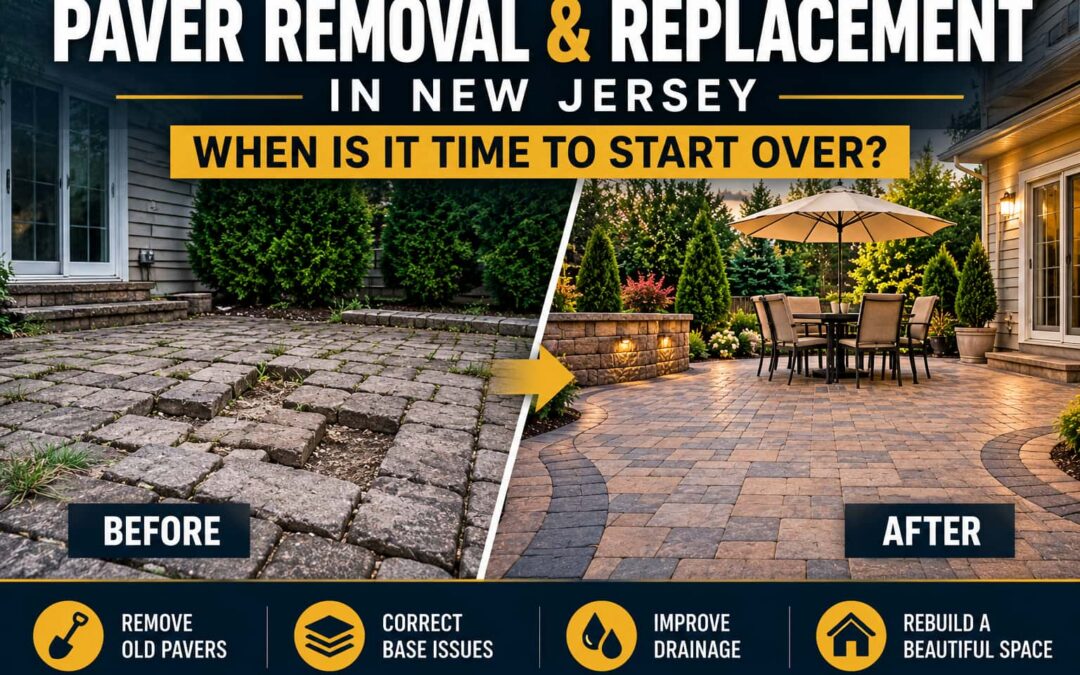
paver removal and replacement New Jersey
Paver removal and replacement may be necessary when an existing patio, walkway, or driveway has widespread settlement, recurring drainage problems, extensive damage, or an inadequate base that makes repeated repairs impractical. However, not every damaged paver surface needs complete replacement—localized problems can often be repaired when the underlying installation remains structurally sound. Resources from the National Association of Home Builders (NAHB) can also provide helpful information when evaluating home improvement and construction projects.
For New Jersey homeowners, the key is determining whether you’re dealing with an isolated problem or a failure affecting the overall paver system.
Before tearing everything out, here’s what you should know.
Should You Repair or Replace Your Existing Pavers?
This is usually the first question homeowners ask when an older patio or walkway starts looking uneven.
The answer depends less on the age of the pavers and more on why the surface is failing.
A few sunken pavers don’t necessarily justify replacing an entire patio.
But when multiple areas continue sinking, drainage problems keep returning, edges are spreading, and previous repairs aren’t holding, the underlying installation may require more extensive correction.
A professional evaluation should look beyond the visible pavers and examine:
- Overall settlement
- Base condition
- Drainage
- Grading
- Edge restraints
- Existing soil conditions
- Surface elevations
- Previous repairs
- Condition of the pavers themselves
The goal should be identifying the cause before deciding on the solution.
1. Multiple Areas Are Sinking
A localized low spot can sometimes be repaired by removing the affected pavers and correcting the area underneath.
The situation changes when settlement appears throughout a large portion of the patio or walkway.
Widespread sinking can indicate a larger problem involving the base, soil, drainage, or original installation.
Signs can include:
- Numerous low spots
- Waves across the surface
- Pavers sitting at different elevations
- Water accumulating in several areas
- Sections repeatedly becoming uneven
At that point, repeatedly repairing individual sections may become inefficient.
Removing the existing pavers and rebuilding the foundation may provide an opportunity to address the problem more comprehensively.
2. You’ve Repaired the Same Areas More Than Once
Recurring problems deserve attention.
Suppose one section of your patio sinks. It’s repaired.
A year later, it sinks again.
It’s repaired again.
Then another nearby section begins moving.
At some point, the question should change from:
“How do we level these pavers?”
to:
“Why does this area keep moving?”
Repeated failure can suggest that the underlying cause hasn’t been corrected.
That could involve drainage, erosion, soil movement, base preparation, or another site-specific issue.
Continuing to perform cosmetic repairs without identifying the cause can mean repeatedly paying to address the same symptoms.
3. Drainage Problems Affect the Entire Patio
Water is one of the most important considerations in any hardscape project.
If one small area collects water, a localized grading correction may potentially solve the problem.
But if water flows incorrectly across much of the patio—or toward the house—the solution can become more complicated.
Widespread drainage problems may require reconsidering:
- Patio elevation
- Surface pitch
- Base construction
- Nearby landscaping
- Downspout locations
- Drainage systems
- Relationship to surrounding surfaces
Correcting those issues may require removing substantial portions of the existing installation.
4. The Original Base Wasn’t Built Properly
The pavers you see are only the finished surface.
Their long-term performance depends heavily on what’s underneath.
A typical paver system may involve prepared soil, aggregate base material, a bedding layer, pavers, joint material, and edge restraints.
If the foundation wasn’t constructed appropriately for the site and intended use, problems can eventually appear above it.
Possible warning signs include:
- Extensive settlement
- Recurring low areas
- Significant movement
- Separating edges
- Persistent unevenness
When the foundation itself is the problem, replacing only the visible pavers won’t correct it.
5. Your Patio No Longer Fits Your Backyard
Not every paver replacement project begins because something failed.
Sometimes the existing patio simply doesn’t work for the homeowner anymore.
Perhaps it was installed when the house had different owners.
Maybe it’s too small.
Perhaps you’re adding:
- An outdoor kitchen
- Fire pit
- Pergola
- Pool
- Dining area
- New landscaping
- Retaining walls
- Larger entertainment space
In those situations, removing the old pavers can provide an opportunity to rethink the entire outdoor environment.
Instead of simply replacing an old patio with another patio of exactly the same dimensions, consider how you actually want to use the backyard.
6. The Existing Pavers Are Severely Damaged
Individual damaged pavers can often be replaced.
Widespread deterioration is different.
If large numbers of pavers are damaged, heavily deteriorated, or no longer suitable for the desired design, replacement may become more practical than attempting to salvage every piece.
The existing material should be evaluated before automatically assuming everything needs to be discarded.
Can Old Pavers Be Reused?
Potentially.
One of the advantages of a segmental paver system is that the individual units can sometimes be removed and reused.
If the pavers themselves remain in good condition but the foundation underneath needs reconstruction, some or many of the existing units may potentially be reinstalled.
This should be evaluated project by project.
The contractor should inspect the existing pavers for:
- Cracks
- Chips
- Excessive wear
- Staining
- Surface deterioration
- Size consistency
- Availability of matching replacements
Reusing existing pavers may also make sense when homeowners like their current design but need the installation underneath corrected.
What Happens During Paver Removal and Replacement?
The exact process depends on the property, but a replacement project may involve several stages.
Step 1: Evaluate the Existing Surface
Before demolition begins, determine why the existing installation failed or why it’s being replaced.
This is critical.
Otherwise, a new surface could potentially reproduce problems from the old one.
Step 2: Remove Existing Pavers
Existing pavers are carefully removed.
If reuse is being considered, reusable materials should be separated from damaged pieces.
Step 3: Inspect the Existing Base
Once the pavers are removed, the contractor has something homeowners rarely get to see:
the foundation underneath the patio.
This can reveal issues involving settlement, inadequate material, erosion, drainage, or other conditions.
Step 4: Remove or Correct Problematic Material
Depending on the condition of the existing installation, portions of the old base may need to be removed or reconstructed.
Step 5: Correct Drainage and Grade
This is an important opportunity.
If the old patio had standing water or poor drainage, rebuilding the surface allows the contractor to reconsider elevations and water movement before installing new pavers.
Step 6: Prepare and Compact the New Base
The new paver system needs a properly prepared foundation appropriate for the site and intended use.
Step 7: Install the Pavers
New or reusable pavers are installed according to the selected layout and design.
Step 8: Complete Edges and Joints
The perimeter and joints are completed as required by the selected paver system.
Step 9: Inspect the Finished Project
The final surface should be evaluated for alignment, elevations, drainage, and overall appearance.
Paver Repair vs. Replacement: Quick Comparison
| Existing Condition | Repair May Be Appropriate | Replacement May Be Considered |
|---|---|---|
| Few sunken pavers | Yes | Usually unnecessary |
| One isolated low area | Often | Depends on underlying cause |
| Localized edge movement | Often | If damage is widespread |
| Multiple recurring low areas | Possibly | Worth evaluating |
| Widespread base problems | Limited | Often worth considering |
| Major drainage problems | Depends on cause | May require extensive reconstruction |
| Good pavers, failed base | Pavers may be reusable | Base may require rebuilding |
| Severely damaged pavers | Individual replacement possible | Consider if widespread |
| Patio too small | Repair won’t change layout | Replacement/expansion may make sense |
| Complete backyard redesign | Limited benefit | Creates design flexibility |
Can You Install New Pavers Directly Over Old Pavers?
Homeowners sometimes ask whether new pavers can simply be installed over an existing paver patio.
That shouldn’t automatically be considered the easiest solution.
Adding another surface changes elevation and can affect:
- Steps
- Door thresholds
- Drainage
- Surrounding landscaping
- Walkways
- Retaining walls
- Pool areas
- Other structures
More importantly, if the existing patio is already sinking or moving, covering it doesn’t necessarily address the cause.
The existing conditions should be evaluated first.
What About Removing an Old Concrete Patio for Pavers?
Some paver projects begin with concrete removal rather than paver removal.
An old concrete patio may be:
- Cracked
- Uneven
- Poorly positioned
- Too small
- Difficult to integrate with a new landscape design
Removing the existing surface allows the contractor to evaluate the area and build the new paver system according to the requirements of the property.
The correct approach depends on existing conditions, elevations, drainage, and the proposed design.
Why New Jersey Conditions Matter
New Jersey’s seasonal weather places outdoor hardscapes through significant environmental changes.
Properties experience:
- Heavy rainfall
- Snow
- Ice
- Freezing temperatures
- Thawing
- Summer heat
Water and freeze-thaw conditions can expose weaknesses in an improperly constructed surface.
That’s why replacing pavers without addressing drainage or foundation problems underneath them can be a mistake.
A replacement project should be viewed as an opportunity to correct the system, not merely change the visible material.
Before-and-After Evidence Homeowners Should Ask For
When evaluating a paver contractor, don’t only ask to see photographs of completed patios.
Ask whether they can show you:
Before → Removal → Base Preparation → Installation → Finished Project
Why?
Because almost every new patio can look attractive immediately after installation.
Photographs of excavation and base preparation provide more information about how the contractor actually builds the project.
Questions to Ask Before Replacing Your Pavers
Before approving complete removal, ask your contractor:
- Why do you recommend replacement instead of repair?
- What caused the existing surface to fail?
- Can any existing pavers be reused?
- What condition is the existing base in?
- Will the old base be removed?
- How will drainage be improved?
- Will the patio elevation change?
- Can the patio be expanded?
- Should surrounding landscaping be redesigned?
- How will the new base be prepared and compacted?
A contractor should be able to explain why removal is necessary.
Don’t Replace Pavers Until You Understand Why the Old Installation Failed
This is the most important takeaway.
If an existing paver patio failed because of poor drainage, rebuilding it without changing the drainage strategy can potentially recreate the same problem.
If the base was inadequate, simply installing expensive new pavers won’t fix the foundation.
If tree roots caused movement, the surrounding landscape needs to be considered.
The new project should address the cause of the old problem, not simply cover it with new materials.
Paver Removal and Replacement in New Jersey
Sometimes repairing existing pavers is the sensible solution.
Other times, removing the existing installation creates an opportunity to rebuild the foundation, improve drainage, redesign the space, and create an outdoor area that better fits the property.
The right decision depends on what’s happening both above and below the surface.
American Pavers & Landscaping LLC provides residential paver installation, paver repair, paver removal, replacement, and landscaping services.
If your existing patio, walkway, or other paved area has recurring problems—or you’re ready to redesign your outdoor space—contact American Pavers & Landscaping LLC to discuss the project.
Contact American Pavers & Landscaping LLC
Phone: (609) 384-1357
Email: info@americanpaversnj.com
Website: https://americanpaversnj.com/