
paver patio installation New Jersey
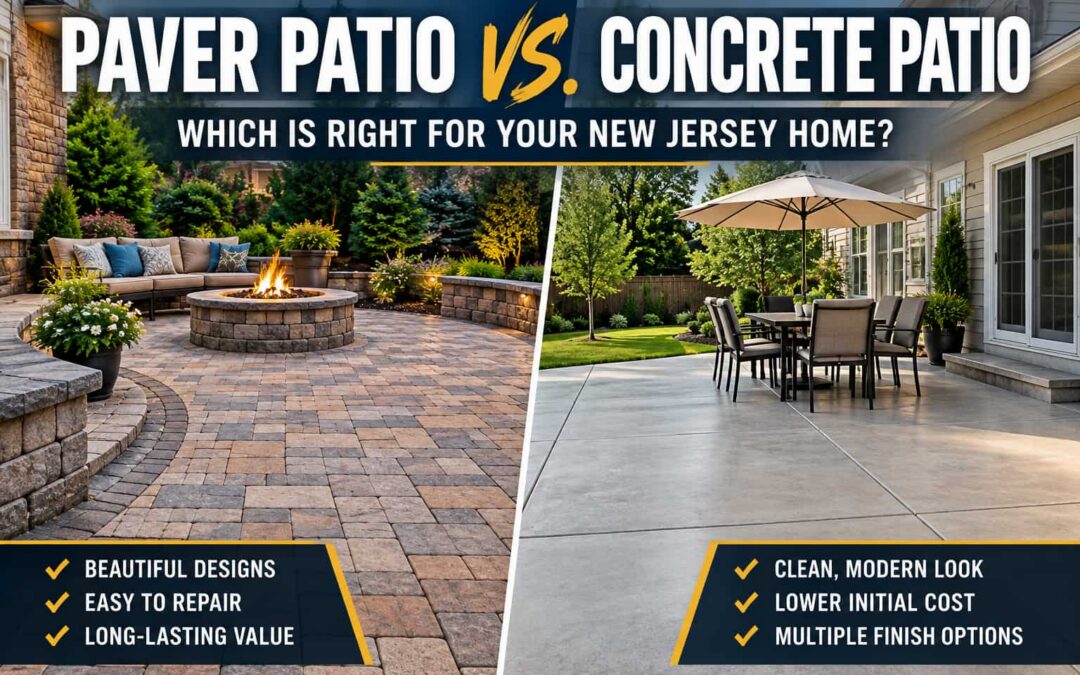
Pavers and concrete can both create functional outdoor patios, but they differ significantly in installation, appearance, repairability, maintenance, and how they respond to movement over time. For New Jersey homeowners, factors such as drainage, freeze-thaw conditions, long-term repairs, design preferences, and site preparation should all be considered before choosing a patio material. Resources from Rutgers University’s School of Environmental and Biological Sciences provide additional information related to environmental and landscape considerations that can be relevant when planning outdoor spaces in New Jersey.
If you’re planning a new backyard patio, don’t make the decision based only on the initial price. Understanding how each system is constructed and maintained can help you choose an outdoor surface that better fits your property and long-term plans.
What’s the Difference Between a Paver Patio and a Concrete Patio?
The biggest difference is how the surface is constructed.
A traditional concrete patio creates a continuous poured surface. A paver patio uses individual manufactured or natural paving units installed as part of a prepared system.
That distinction affects more than appearance.
It can influence:
- Installation
- Drainage
- Repairs
- Design flexibility
- Surface movement
- Maintenance
- Future modifications
Both options can work for residential properties, but they don’t behave exactly the same way.
1. Appearance and Design Options
One of the major attractions of pavers is design flexibility.
Pavers are available in numerous:
- Shapes
- Sizes
- Textures
- Colors
- Patterns
- Borders
- Finishes
Homeowners can combine different paver styles to create borders, accent areas, pathways, seating areas, and other visual features.
This can be especially useful when designing a patio that needs to complement an existing home, pool, retaining wall, outdoor kitchen, or landscape.
Traditional concrete generally creates a more continuous and uniform appearance, although decorative finishes and other treatments can expand the available design options.
2. What Happens When the Ground Moves?
This is an important consideration for New Jersey homeowners.
Outdoor surfaces don’t exist independently of the soil underneath them.
Changes in soil conditions, water movement, freezing and thawing, erosion, roots, and inadequate base preparation can all contribute to surface movement.
Because concrete forms a continuous slab, significant movement can sometimes result in visible cracking.
A paver system consists of individual units. When localized movement occurs, an affected section may sometimes be removed, the underlying problem corrected, and the existing pavers reinstalled.
That doesn’t mean pavers cannot sink or shift.
They absolutely can—especially when the underlying installation isn’t properly prepared.
The advantage is that localized paver problems can sometimes be addressed without replacing the entire patio.
3. Repairability
This is one of the differences homeowners should consider before installation.
Imagine that several years after completing your patio, you need access underneath part of the surface for drainage, utilities, or another property improvement.
With individual pavers, a section may potentially be removed and later reinstalled.
Similarly, if a localized area sinks because of an underlying issue, contractors may be able to lift the affected pavers, correct the base, and reset them.
With a continuous concrete surface, localized repairs can be more visually noticeable depending on the type and extent of damage.
4. Which Handles New Jersey Winters Better?
Neither material should be considered immune to winter-related problems.
New Jersey properties experience repeated:
Freezing → thawing → freezing → thawing
Water management becomes especially important during these cycles.
The performance of either patio depends heavily on factors such as:
- Site preparation
- Drainage
- Soil conditions
- Base construction
- Installation quality
- Surrounding landscape
This is why homeowners should pay attention to the entire installation system, rather than simply comparing the visible materials.
A premium paver installed over a poorly prepared base can still develop problems.
5. Drainage Matters More Than Many Homeowners Realize
One of the most important questions before building a patio is:
Where will the water go?
A patio should be designed with the surrounding property in mind.
Contractors should evaluate how water currently moves around:
- The foundation
- Downspouts
- Lawn areas
- Garden beds
- Retaining walls
- Walkways
- Neighboring surfaces
Installing a beautiful patio without considering water movement can create problems that aren’t immediately apparent on installation day.
Drainage should therefore be part of the planning process—not something addressed only after standing water appears.
6. Paver Patio Maintenance
Pavers aren’t completely maintenance-free.
Over time, a paver patio may require attention to:
- Joint material
- Surface cleaning
- Weeds or vegetation
- Edge areas
- Settlement
- Drainage
- Individual damaged pavers
The amount of maintenance depends heavily on the installation, environment, materials, usage, and surrounding landscaping.
Regularly inspecting the patio can help homeowners identify small changes before they develop into larger issues.
7. Concrete Patio Maintenance
Concrete patios also require maintenance.
Depending on the installation and conditions, homeowners may eventually encounter:
- Cracks
- Surface staining
- Discoloration
- Joint deterioration
- Settlement
- Drainage concerns
The specific maintenance requirements vary according to the concrete system, installation quality, exposure, and property conditions.
Pavers vs. Concrete: Quick Comparison
| Factor | Paver Patio | Concrete Patio |
|---|---|---|
| Construction | Individual paving units | Continuous poured surface |
| Design Choices | Extensive patterns, colors and textures | Multiple finishes available |
| Localized Repair | Individual sections may be removable | Repair may be more visible |
| Surface Movement | Individual units can move | Movement may produce cracking |
| Drainage Planning | Essential | Essential |
| Base Preparation | Critical | Critical |
| Custom Borders | Easy to incorporate | Depends on design |
| Future Access Below Surface | Sections may potentially be removed | Usually requires cutting/removal |
| Maintenance | Joints, cleaning and occasional resetting | Cleaning, joints and potential crack repair |
| New Jersey Climate | Proper installation is critical | Proper installation is critical |
Which Is Cheaper: Pavers or Concrete?
This is one of the most common questions homeowners ask, but comparing only the initial installation price can be misleading.
Project pricing can vary according to:
- Patio size
- Excavation requirements
- Existing surface removal
- Site accessibility
- Drainage work
- Base preparation
- Material selection
- Pattern complexity
- Borders
- Steps
- Retaining walls
- Landscape integration
Traditional concrete can sometimes have a lower initial installation cost than more elaborate paver systems, but actual estimates should be compared based on equivalent scopes of work.
A very low estimate isn’t necessarily a better value if important site preparation is excluded.
The Question Homeowners Should Ask Instead
Instead of only asking:
“How much per square foot?”
Ask:
“What exactly is included underneath the finished surface?”
Two patios can look similar immediately after installation while being constructed very differently underneath.
Ask potential contractors about:
- Excavation
- Base preparation
- Compaction
- Grading
- Drainage
- Edge restraints
- Removal of existing materials
- Cleanup
Understanding the complete scope makes estimates easier to compare.
When Does a Paver Patio Make Sense?
Pavers may be worth considering when a homeowner prioritizes:
- Extensive design flexibility
- Decorative patterns and borders
- Integration with existing hardscaping
- The ability to potentially repair localized areas
- Future expansion possibilities
- A customized outdoor living environment
Pavers can also work particularly well when the patio is part of a larger landscape project involving walkways, retaining walls, fire pits, outdoor kitchens, or other hardscape elements.
When Might Concrete Make Sense?
Concrete may be worth considering when the homeowner prefers a continuous surface or a particular concrete finish and the project requirements make it an appropriate material.
The correct choice depends on the property, budget, intended use, design goals, and long-term expectations.
There isn’t one material that’s automatically right for every home.
Don’t Forget About the Rest of the Backyard
A common mistake is designing the patio as an isolated rectangle.
Before construction, think about how people will move between:
House → Patio → Lawn → Walkway → Garden → Pool or Entertainment Area
The patio should become part of the overall landscape.
Planting beds, walkways, retaining walls, outdoor lighting, steps, and other landscape elements can make the finished project feel integrated with the property.
What Should You Ask a Paver Contractor?
Before choosing a contractor, consider asking:
How will you prepare my property before installing the pavers?
Then ask:
- How will the area be excavated?
- What type of base will be installed?
- How will the base be compacted?
- How will you handle drainage?
- How will the patio be graded?
- What happens if poor soil conditions are discovered?
- How will the edges be secured?
- Can I see examples of similar projects?
- What maintenance should I expect?
A contractor should be able to explain the construction process—not simply show you a catalog of paver colors.
Build the Patio From the Ground Up
The most attractive paver in the showroom won’t compensate for poor installation underneath it.
A successful patio starts with understanding the property, preparing the site correctly, controlling drainage, building an appropriate base, and installing the selected materials according to the project’s requirements.
The visible pavers are the finishing layer of a much larger system.
If you’re considering a paver patio installation in New Jersey, American Pavers & Landscaping LLC can help evaluate your property and discuss options for creating an outdoor space that works with your home and landscape.
Contact American Pavers & Landscaping LLC
Phone: (609) 384-1357
Email: info@americanpaversnj.com
Website: https://americanpaversnj.com/